
The Creative

Blurring the Lines of What is Beautiful and What is Useful.
Core philosophy:
The philosophy of the Creative bohemian is a quiet but profound rebellion against the modern world's obsession with speed, disposability and mass production. At its heart it is the belief that a life and a living are things that must be mindfully made, not just passively consumed.
The Creatives philosophy blurs the lines between functionality and beauty. They believe that the objects we use every day should be imbued with meaning and artistry. A hand thrown cup that warms perfectly in your hands, a beautifully crafted shamanic drum, or a comfortable hand-knit jumper are all expressions of this belief. By creating and using these pieces of functional art, they elevate daily routines into moments of beauty. This act of bringing soul into useful every day items is their form of activism - a gentle persistent revolution against a throwaway culture, proving that a more intentional, crafted and beautiful way of living is not only possible but something that you can build with your own two hands.
Ultimately the Creatives work is an act of connection. In a world of anonymity, the create a tangible piece of their own life story and offer it to the world. They are the keepers of traditional skills and the weavers of new ones, sharing their work not for fame or fortune but to foster a sense of community and shared humanity. Whether they are playing their music in a local cafe, acting in a small theatre or selling their creations at a local market, their creative expression is a bridge between souls. It is an invitation for others to slow down, appreciate the beauty in the functional and to remember that the most meaningful things in life are crafted with skill, passion and a piece of one's soul.
_edited_edited.jpg)
_edited.jpg)
_edited.jpg)
Daily Life:
As the golden hour spills over the rooftops of the city around them, the Creatives day of work is gently winding down. Like each of the other bohemian archetypes, the day of the Creative bohemian did not begin with a frantic alarm and rushed commute, but with the soft light of the sun and the savouring of a invigorating cup of coffee.
The first hour was not spent reading and responding to emails, but with a sketchbook, and a quiet mind, planning the days creative flow - deciding which stage of a project needed their focus, whether it was the throwing of clay, sanding down a piece of reclaimed wood or working through a difficult musical composition.
The creatives schedule is dictated by the needs of their craft and their own creative energy, not the hands of the clock. As they lose themselves to the flow of creativity and a deep immersive focus, the hours would have flown past as the lights and shadows of the day danced their way around the room. For hours, the world outside their workshop or studio would have faded away, the only sound been the gentle whirl of the potters wheel, the rhythmic scrape of a chisel, or the repeated strumming of a chord progression.
This period of intense, meditative work is the core of their experience. Lunch would have been a simple, nutritious meal, perhaps followed by a walk to the local park or to a small, independent supplier to pick up materials and chat to the owner.
Now as the evening seeps in, they are likely cleaning their tools with the same care that they use to create, tidying their space to prepare it for the next day's inspiration.
The days end isn't marked by a time-card but by a feeling of satisfaction - a deep sense of having brought something new and beautiful into the world, one mindful moment at a time.
_edited.jpg)
_edited.jpg)
.png)
Home:
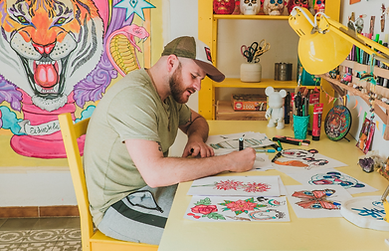
The home of the Creative bohemian is a space where the line between life and work completely dissolves. It's a living gallery and a functional workshop fused into one, a place where every object and surface tells a story of its creation. Unlike a conventional home where work is hidden away, the Creatives creative space is the heart of the home. The living room might be dominated by a large easel that is positioned to catch the best light, a guitar sits in the corner where the acoustics are best heard, and a typewriter takes pride of place on the desk.
Tools are not tidied away into neat boxes but are kept close at hand, becoming a part of the decor - a row of chisels arranged by size, a colourful collection of threads pinned to a corkboard, and a recently finished creation sits drying atop a piece of newspaper on the bookshelf.
The air itself is often scented with the materials of their craft: damp clay, linseed oil, or sawdust.
-
"Your home should tell the story of who you are, and be a collection of what you love." - Nate Berkus.
-
"The house of a creative person is both a laboratory and a playground." - Constance Spry.
-
"Be faithful to your own taste because nothing you really like is ever out of style." - Billy Baldwin.


Community: A Creative Collective.
The community of this creative soul is a warm supportive guild of kindred spirits built on a foundation of mutual respect for the act of creation. It is less a formal network and more a woven tapestry of of fellow makers and creators, where a potter, a musician, a jeweller and a painter are all united by a shared passion for their craft and a collective appreciation for the handmade.
Unlike the cut-throat competition of the mainstream art and business worlds, the Creatives community is inherently collaborative. They are the first to celebrate each other's successes, whether it's a sold out market stall, or a beautifully executed new piece. They actively support one another by sharing knowledge, trading skills, and offering honest constructive feedback. It's not uncommon to see a musician playing at the opening of an artist's small exhibition. Their connections are built on the understanding that a rising tide lifts all boats.
This community thrives in unhurried, authentic spaces. You'll find them connecting at local craft markets which serve as a public square for trade and talk. They gather at independent cafes that support local artists, and they attend or host small workshops to share their skills. Their network is built slowly, over shared cups of coffee and conversations about the challenges and joys of their work. It's a community that provides not just practical support, but the essential emotional and creative nourishment that allows this creative soul to flourish in a world geared towards speed and mass production.
-
"The communal genius of market place and street corners...is 'scenius'. Scenius is the intelligence and intuition of a whole cultural scene. It's the communal form of the concept of the genius." - Brian Eno.
-
"Creativity is contagious, pass it on." - Unknown.
-
"Art is our one true global language. It knows no nation, it favours no race, and it acknowledges no class. It speaks to our need to reveal, heal and transform." - Richard Kamler.
-
"There is no such thing as a self made man. You will reach your goals only with the help of others." - George Shinn.
_edited.jpg)
.png)
.png)
Creative expression: Turning the functional into works of art.
For the Creative Soul, creative expression is the very fabric of their existence. It is an immersive daily practice rather than a performance. Their art is not loud or declarative but is found in the quiet, focused dedication of their chosen craft. The medium itself is the message, and their expression is communicated through the skilful and soulful manipulation of physical materials.
The Artisan Souls creativity is a slow, meditative conversation between their hands and their materials. It's about a deep, almost spiritual connection to the process - the way in which the piece of wood yields to the chisel, the way the glaze transforms in the fire, or the way a melody takes shape through countless hours of practice. Their expression is imbedded in the final object, telling a story through its form, texture, and those subtle imperfections that show that it was lovingly crafted by the hands of the artist rather than a machine. A mug isn't just a vessel, it's an expression of balance and comfort, designed to fit just right in the users hands as they savour their sweet cup of chocolate before bed.
Ultimately their creative expression is a form of quiet rebellion in a disposable world. They create their objects to not only be used, but loved and woven into the fabric of daily life. The act of making useful things beautiful, and beautiful things useful is the core artistic statement of the craftsperson. A hand dyed scarf, a beautifully crafted chair, and a perfectly sculpted violin are not just products, they are expressions of the soul of their creator. Each piece a testament to patience, skill and the profound beauty that can be found in the things we use every day, making their entire life a masterpiece of creative expression.
Click here to find out more about the different forms of creative soul style, and discover which creative style describes you best.
-
"The whole culture is telling you to hurry, while the art tells you to take your time. Always listen to the art." - Junot Diaz.
-
"The urge to destroy is also a creative urge." - Mikhail Bakunin.
-
"If I could say it in words, then there would be no reason to paint." - Edward Hopper.
-
"we don't make mistakes, just happy little accidents." - Bob Ross.
-
"To practice any art, no matter how well or how badly, is a way to make your soul grow. So do it!" - Kurt Vonnegut.
.png)
_edited.jpg)
.png)
Financial survival:
Financial survival for the Artisan Soul is a carefully crafted balancing act, driven by a philosophy that places creative integrity and personal wellbeing well above conventional wealth accumulation. They are not anti-capitalist in the way that the Freethinker/Activist is, rather, they operate within a micro economy of their own making, one built on skill, community, and fair value.
Their financial model is rarely based on a single source of income. Instead, they create a resilient, diversified web of revenue streams that all stem from their core craft.
These include:
-
Direct-to-customer sales: You will find them as regulars at local craft fairs, seasonal markets and village halls. This model allows them to sell directly, tell the story of their work, and build up a loyal customer base.
-
Online platforms: They will often have a presence on platforms like Etsy, Instagram, or a personal website, which allows them to reach a wider audience while still controlling their brand and pricing.
-
Teaching and workshops: A significant income stream comes from sharing their skills. They run workshops from their home or studio, in local community centres, adult education colleges, art hubs or even through online courses. This not only provides income but also reinforces their role in the community.
-
Selective commissions: They will take on commissioned work so long as it aligns with their artistic vision. This provided larger less frequent injections of cash.
The Artisan Soul does does not compete with the price of mass-produced goods. a core part of their financial strategy is to gently educate their customers on the value of time, skill, and quality materials. they practice 'right pricing', charging what a piece is truly worth, which allows them to work at a sustainable, mindful pace.
This is made possible by a deliberately low overhead lifestyle. Their largest expense, their home, almost always doubles as their studio, eliminating the cost of a separate workspace. They are resourceful, often buying tools second hand, or trading for materials. Like their bohemian cousins, they eschew expensive trends and consumer debt, finding richness in a simple meal with friends or a walk for inspiration, rather than material possessions. Their financial survival is the ultimate expression of their craft: a slow, intentional and beautifully constructed life.
Know that you have an Artisan Soul but not yet how to pursue it?
Follow us over to the Creativity section to find your creative soul expression with our creative soul expression quiz.
-
"Making money is art, and working is art, and good business is the best art." - Andy Warhol.
-
"Instead of the 'starving artist', I've been calling myself 'the trying artist;, I'm not starving, I'm trying to make a living." - Amanda Palmer.
-
"The art of art, the glory of expressionism and the sunshine of the light of letters is simplicity. To know hoe to say what others only know how to think is what makes men poets or sages: and to profit by that is what makes them worldly-wise." - Oscar wilde.
-
"Don't be an artist. It's a miserable, thankless life. If you have to be an artist, do it, but don't say that I didn't warn you." - John Waters.
-
"Every artist was once an amateur." - Ralph Waldo Emerson.
_edited_.jpg)
_edited.jpg)
.png)
Are You Ready to Dedicate Your Life to the Pursuit of Your Art?
Phase 1 - Find Your Medium (The Spark):
This initial phase is about exploration and rediscovering your innate human creativity without pressure.
-
Reconnect with Your Hands: Before you even choose a craft, spend some time simply making things without a goal. Knead dough to bake bread, try gardening, learn to knit a simple square, doodle in a notebook. The aim is to awaken your tactile senses and break down the fear of not being "artistic."
-
"Date" Your Craft: Explore Widely Don't commit immediately. Treat this stage like dating. The West Midlands is full of opportunities for this. Take a one-day pottery taster course (places like Sundragon Pottery at The Old Print Works are great for this). Sign up for a beginner's life drawing session at the Midlands Arts Centre (MAC). Try a woodworking, weaving, or jewellery-making workshop. The goal is to find the medium that feels right in your hands and sparks a genuine excitement.
-
Choose Your Path: Commit to One Once you find a craft that captivates you, make a small, intentional commitment. You don't need a full studio, but invest in a basic, quality set of starter tools. Designate a small corner of your home as your creative space. This act of commitment is the true starting point.
Phase 2 - Develop Your Practice (The Dedication):
This is where the "Soul" becomes the "Artisan." It's about building skill and discipline with patience and joy.
-
Become a Student of Your Craft: Respect the craft by learning its fundamentals. Enrol in a longer, more structured course to build a solid technical foundation. Read books, watch videos, and study the work of masters in your field. The Artisan Soul finds deep satisfaction in skill and knowledge, not just inspiration.
-
Create Your Ritual: Build the Habit Integrate your craft into your daily or weekly rhythm. Set aside dedicated, non-negotiable time for it, even if it's just 30 minutes every evening. This consistent practice, or 'ritual', is far more important than waiting for a flash of inspiration. It builds muscle memory, discipline, and turns your craft into a meditative part of your life.
-
Embrace Imperfection: Find Your Voice This is the most important mindset shift. You will make things that are wonky, flawed, and not what you envisioned. Do not see these as failures. See them as the marks of the human hand, the "wabi-sabi" that makes your work unique. Your personal style - your creative voice, will emerge from these happy accidents and imperfections, not from a quest for sterile perfection.
Phase 3 - Integrate and Share (The Community):
This phase is about letting your craft bleed into the rest of your life and connecting with others.
-
Carve Out Your Studio Space: As you progress, allow your creative space to become a more permanent and inspiring part of your home. A dedicated workbench, a potter's wheel in the living room, or a loom by the window blurs the line between your life and your art, making creativity an ever-present possibility.
-
Find Your Guild: Connect with Community You are not alone. Start visiting local craft markets, like the ones in Moseley or Kings Heath, not necessarily to sell, but to talk to other makers. Ask them about their process. Compliment their work. Search for local guilds or artist collectives online. This community will become your source of support, inspiration, and collaboration.
-
Share Your Work: Complete the Cycle The final step is to let your creations go out into the world. This doesn't have to be a big commercial enterprise. Start by gifting your work to friends and family. Perhaps share a stall with a friend at a small local fair. The act of sharing - of having something you made with your own hands be used and loved by someone else - is the final, deeply satisfying piece of the Artisan Soul's journey.